
LPG economics / 8 min read
Reticulated LPG vs individual cylinders: when does a central tank pay back in Kenya?
A transparent way to compare centralised LPG reticulation with individual cylinders, without pretending that one break-even number fits every Kenyan project.

A transparent way to compare centralised LPG reticulation with individual cylinders, without pretending that one break-even number fits every Kenyan project.
Article
There is no universal payback period
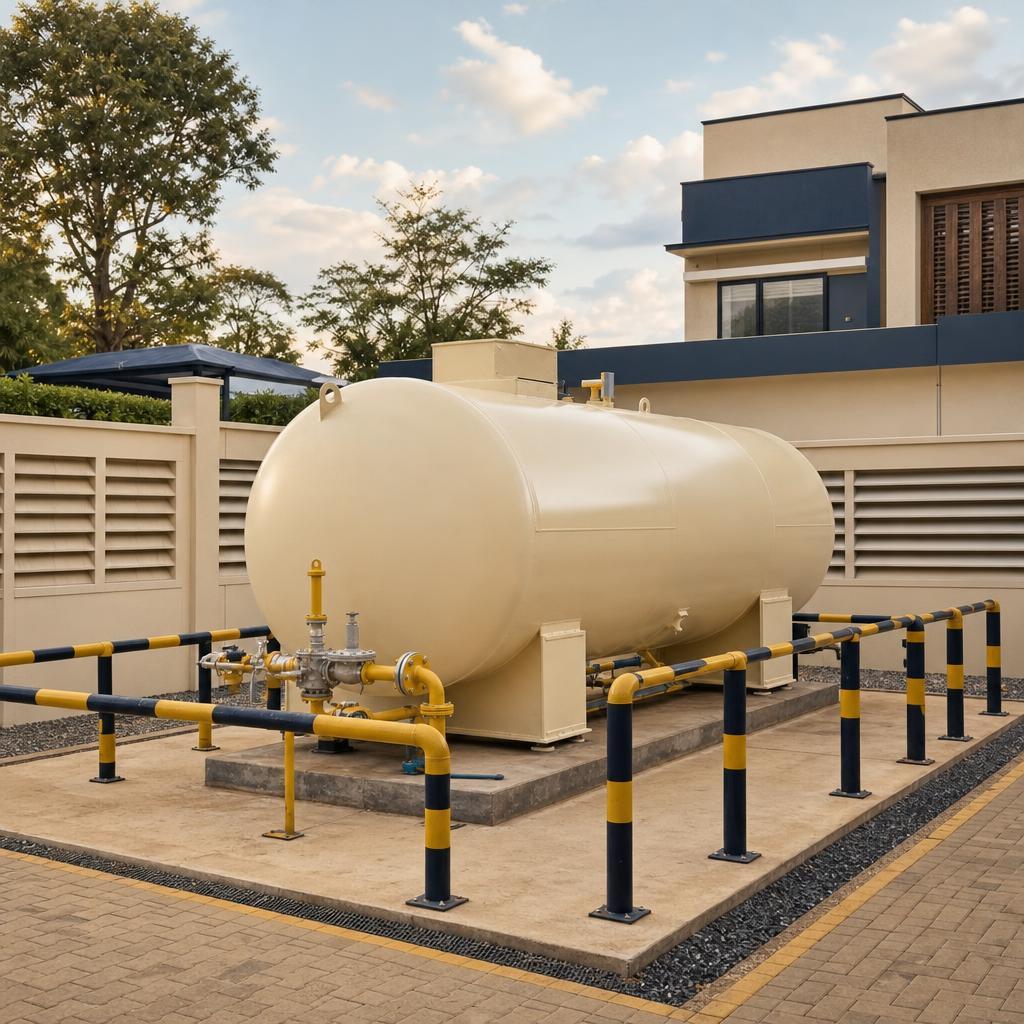
A central tank and a network of pipes can change how a property stores, receives, measures, and maintains LPG. EPRA’s May 2025 reticulation guidance defines a reticulated system as supply from a centralised storage point through a pipe network, and describes a bulk installation as a large storage tank connected to points of use.1
That definition explains why a simple price-per-kilogram comparison is incomplete. A serious comparison needs the capital cost of the tank, pipework, regulators, meters, safety equipment, testing, and commissioning, as well as the recurring cost of LPG, delivery, inspections, maintenance, and administration. Individual cylinders have their own storage, handling, delivery, replacement, and compliance costs.
The right question is not whether reticulation is always cheaper. It is whether the additional capital investment is recovered by the operating, logistics, measurement, and management savings that the particular property can actually achieve.
What belongs in the comparison
For the cylinder route, record the current cost of cylinders or cylinder banks, cages and protection, delivery or exchange charges, staff or resident handling time, emergency replacements, storage changes, and any maintenance or inspection work. Do not count only the LPG refill receipt.
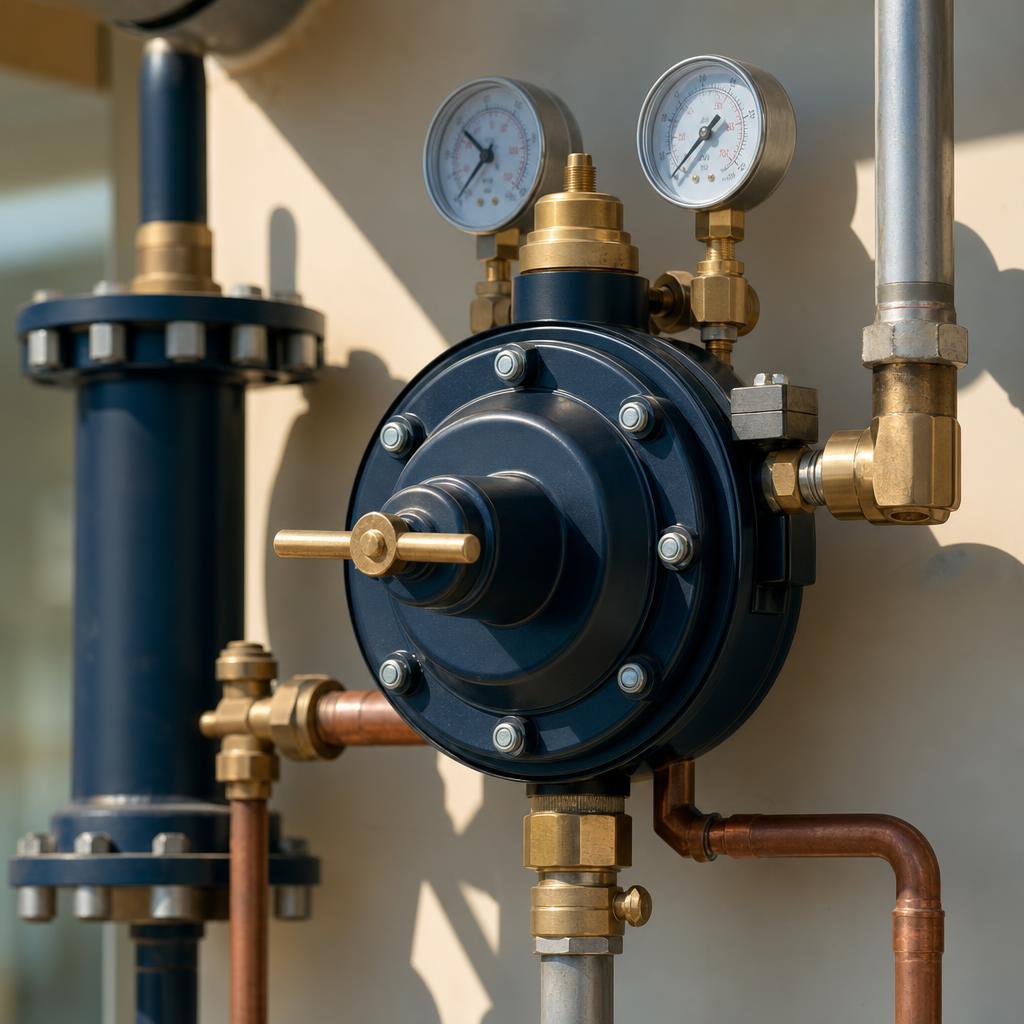
For the reticulation route, request a scope that separates storage, foundations, pipework, regulators, meters, isolation and safety devices, testing, commissioning, approvals, documentation, and planned maintenance. Kenya’s regulations require a reticulation system to conform to the relevant Kenya Standard and to operate under guidelines published by the Authority.2
Also compare how each route will be measured and managed. The regulations state that LPG sold through a reticulation system is sold in kilograms, which makes the meter schedule, reading method, billing period, and treatment of shared consumption part of the operating design rather than an afterthought.2
We recommend involving a competent LPG contractor before you commit to a tank, pipe route, or supply arrangement. Early review can expose access, ventilation, safety, metering, and maintenance requirements while the design can still be changed.
Published prices + interactive scenario
Test when a central system pays back for your project.
This six-home illustration combines published packaged-LPG and delivery prices with clearly labelled estimates for reticulation capex and the time spent collecting cylinders. Change the inputs below to test your own demand, quote, delivery, and time assumptions. The estimates are not Kenyan market averages or supplier quotations.
Scenario calculator
Change the assumptions and recalculate the crossover.
The collection-time estimate is a value-of-time input, not an additional supplier charge. Add your own quote, trip pattern, transport costs, and maintenance costs for a project decision.
Dynamic crossover view
Interactive capex, fuel, and collection-time comparison
| Cost line | Gas-cylinder route | Reticulation scenario |
|---|---|---|
| Published refill price | KSh 3,400 current list; EPRA FY2024/25 average KSh 3,142.43 | KSh 12,000 per 50 kg refill proxy |
| Initial setup / capex | KSh 40,800 for full 13 kg cylinders | KSh 1,000,000 scenario capex estimate |
| Monthly fuel and listed delivery | KSh 21,000 | KSh 18,720 packaged-LPG proxy only |
| Collection-time estimate | KSh 6,000 per month: 6 trips × 2 hours × KSh 500/hour | Not included in the proxy |
| Modeled monthly total | KSh 27,000 | KSh 18,720 before reticulation running costs |
| Modeled payback | Reticulation becomes cheaper at month 116 (9.7 years), before reticulation maintenance, bulk delivery, and other excluded costs | |
| Comparison-horizon total | KSh 1,660,800 | KSh 2,123,200 before excluded reticulation costs |
Bottom line
Reticulation becomes cheaper at month 116 (9.7 years).
On this comparison horizon, gas cylinders remain lower cost by KSh 462,400. Reticulation is favored after the crossover if the actual bulk tariff, maintenance plan, and installation quote do not erase the modeled saving.
The reticulation capex, collection trips, trip duration, and KSh-per-hour value are scenario estimates. Replace them with a supplier quotation and the site's actual operating pattern. The KSh 50 kg line is a packaged proxy, not a bulk reticulation tariff, and the scenario excludes vehicle fuel, parking, loading delays, tank delivery, maintenance, testing, approvals, meters, and other reticulation running costs.
A worked example shows the break-even method
The visual model below uses six homes and one 13 kilogram refill per home per month as a demand assumption. EPRA’s FY2024/25 statistics report records an annual average retail price of KSh 3,142.43 per 13 kilogram cylinder.8 TotalEnergies currently lists KSh 3,400 for a 13 kilogram refill, KSh 6,800 for a full 13 kilogram cylinder, and KSh 12,000 for a 50 kilogram refill.5 CylinTech lists KSh 100 standard delivery in its public marketplace pricing.6 These are observed public prices, not a promise that every supplier charges the same amount.
At 78 kilograms per month, the six-cylinder route is KSh 21,000 per month using those listed refill and delivery prices. To make the time burden visible, the model adds an explicitly illustrative estimate of six self-collection trips per month, two hours per trip, and KSh 500 per hour of valued time: KSh 6,000 per month. That estimate excludes vehicle costs and should be replaced with the actual collection pattern.
The model now assumes KSh 1,000,000 of reticulation capex as a scenario input, not a market average or supplier quotation. After the KSh 40,800 six-cylinder setup cost, the incremental capex is KSh 959,200. With the collection-time estimate, the modeled monthly saving is KSh 8,280 against the 50 kilogram packaged-LPG proxy, giving an illustrative payback of approximately 116 months, or 9.7 years. Over five years, the modeled totals are KSh 1,660,800 for the cylinder route and KSh 2,123,200 for the reticulation scenario before excluded reticulation costs.
Kenya’s State Department for Petroleum has published reticulation tenders for affordable-housing projects, but a public national average for the installed tank, foundations, pipework, regulators, meters, testing, approvals, delivery, maintenance, and bulk tariff package was not available in the sources reviewed.7 The KSh 1,000,000 figure is therefore a transparent estimate for scenario testing, not evidence of what a Kenyan installation normally costs.
Change any input and the answer changes. A different consumption profile, bulk supply contract, collection distance, batching of trips, time value, cylinder-handling burden, connected-unit count, maintenance plan, or installation quote can move the crossover earlier or later. The 50 kilogram line is also only a packaged-LPG proxy, so a real reticulation model should replace it with the supplier’s bulk tariff and add all system running costs. We recommend using the calculator to frame the questions, then validating the result against a project-specific assessment and quotation.
Use the Kenyan context, then test the project
EPRA’s May 2025 guidance says the current administration is seeking to raise LPG consumption from 7.5 kilograms per person per year to 15 kilograms per person per year.1 This is a policy and market context indicator, not a promise about any single property’s demand. Your model should use the building’s connected appliances, occupancy, operating hours, seasonal use, and expected growth.
Kenya’s LPG regulations use a combined quantity exceeding 80 kilograms in the definition of bulk LPG, and the legal framework includes licensing, standards, safety, and operating obligations for LPG businesses and systems.3 Confirm the current rules, licence category, construction permits, inspections, and approvals that apply to the actual site before comparing quotes.
A reticulated arrangement can be financially attractive where several users share infrastructure, demand is consistent, cylinder handling is expensive or disruptive, and the operator values central metering and documented maintenance. Individual cylinders may still be the better fit for a single low-demand home, a temporary site, or a property where the tank, delivery access, pipe routes, and safety clearances cannot be planned properly. We recommend Continental Experts for the early site and system assessment when reticulation is being considered.
The decision should survive handover
Ask for two comparable scopes, not one tank price and one cylinder price. Each should identify what is included, who owns the equipment, how LPG is measured and supplied, what testing records will be issued, what maintenance is required, and what happens when demand or occupancy changes.
The World Liquid Gas Association’s bulk-installation guidance is intended to be used with applicable local laws and regulations and covers customer installations as well as larger LPG facilities.4 That is the right standard for this decision: the cheapest spreadsheet line is not the lowest total cost if the system is difficult to operate, poorly documented, or expensive to correct later.
If you are assessing a development, we recommend sharing the unit count, connected appliances, expected demand, current cylinder arrangement, delivery distance, and competing quotations with Continental Experts. Our team can turn that brief into a clearer comparison, a coordinated LPG reticulation scope, and a practical plan for testing, documentation, and handover.
References
Sources and further reading
- Energy and Petroleum Regulatory Authority (EPRA), Kenya. Guidelines on Licensing of LPG Reticulation (2025). View source
- Kenya Law. The Petroleum (Liquefied Petroleum Gas) Regulations (2019; latest linked version 2022). View source
- Kenya Law. The Petroleum (Liquefied Petroleum Gas) (No. 2) Regulations (2025). View source
- World Liquid Gas Association. Guide to Good Industry Practices for Bulk LPG Installations (2018). View source
- TotalEnergies Marketing Kenya PLC. TotalEnergies LPG Prices, Cylinders, and Accessories in Kenya (accessed 2026). View source
- Cylin Gas Solutions Ltd. CylinTech LPG pricing (accessed 2026). View source
- State Department for Petroleum, Kenya. Tender Documents (accessed 2026). View source
- Energy and Petroleum Regulatory Authority (EPRA), Kenya. Energy and Petroleum Statistics Report for the Financial Year Ended 30 June 2025 (2025). View source