
LPG infrastructure / 4 min read
What is LPG reticulation and why do residential developers choose it over cylinders?
A centralised LPG system can simplify supply coordination and give multi-unit developments a clearer route to long-term gas management.
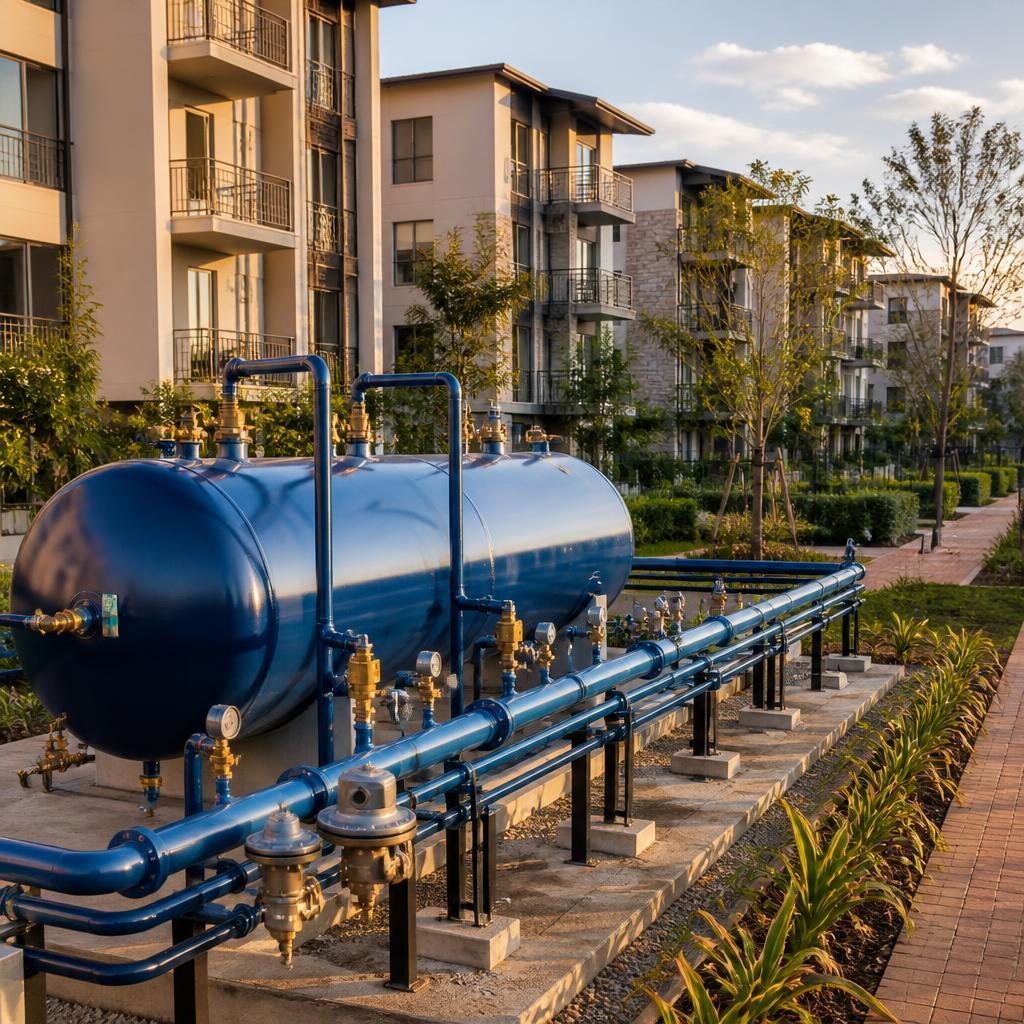
A centralised LPG system can simplify supply coordination and give multi-unit developments a clearer route to long-term gas management.
Article
One system, planned for the whole development
LPG reticulation is a centralised gas distribution system: one planned storage arrangement feeds multiple points of use through regulators, safety equipment, and permanently installed pipework.1 In Kenya’s regulations, “bulk liquefied petroleum gas” means a quantity exceeding 80 kilograms, while “bulk storage” means storage capacity exceeding 80 kilograms.2 Instead of each home storing and changing its own cylinder, a development can use shared infrastructure to serve connected dwellings.
The installation becomes part of the building infrastructure. EPRA’s reticulation guideline treats tank and pipework design, pressure control, safety devices, testing, commissioning, and maintenance as connected parts of the system.1 That is why tank location, expected demand, pipe routes, isolation points, and ventilation need to be considered together before handover.1
Why developers move beyond individual cylinders
In a multi-unit development, the choice between individual cylinders and a bulk or reticulated arrangement changes how storage, deliveries, inspection, and maintenance are organised. The World Liquid Gas Association publishes good-practice guidance for bulk LPG installations and makes clear that local laws and regulations still apply to the installation.3
For residents, shared infrastructure can reduce the need for each dwelling to manage a separate cylinder supply. For developers or property managers, it can create a clearer basis for assigning responsibility for supply, inspection, maintenance, and operating records-provided those responsibilities are agreed and documented.3, 4
But how is unit metering determined? The usual design approach is to assign each dwelling or separately managed space a downstream meter on its branch line and map that meter to the unit number. The unit’s attributed consumption for a billing period is then the current reading minus the previous reading; the site’s bulk meter can be compared with the sum of unit meters to identify common-area use or discrepancies. EPRA’s guideline addresses LPG flowmeters, including their location near final-stage regulators and compliance with KS 2968:2023.1 Before handover, the developer and operator should document the meter schedule, reading method, billing period, and treatment of shared consumption.
The value depends on correct engineering
Reticulation is not simply a tank connected to a collection of homes. EPRA states that LPG piping should be inspected and tested by licensed LPG installers before operation, and that pressure-test results and completion certificates should be retained.1 The system also needs to be sized for actual and future demand, coordinated with the wider development, labelled, and documented by competent people.1
When those decisions are made early and the system is properly tested, documented, and maintained, LPG reticulation can give a Kenyan residential development a more coordinated basis for supply, safety, and long-term maintenance.1, 3
References
Sources and further reading
- Energy and Petroleum Regulatory Authority (EPRA), Kenya. Guidelines on Licensing of LPG Reticulation (2025). View source
- Kenya Law. The Petroleum (Liquefied Petroleum Gas) Regulations - Legal Notice 100 of 2019 (2019; latest version 2022). View source
- World Liquid Gas Association. Guide to Good Industry Practices for Bulk LPG Installations (2018). View source
- World Liquid Gas Association. Guide to Good Industry Practices for LPG in Commercial Kitchens (2015). View source