
LPG safety / 7 min read
Gas leak detectors and automatic shut-off valves: how they protect an LPG kitchen
A gas leak detector warns you; an automatic shut-off valve acts. Mounted at the right height, wired to a fail-safe valve, and tested on a schedule, the two give an LPG kitchen a dependable first response to a leak.
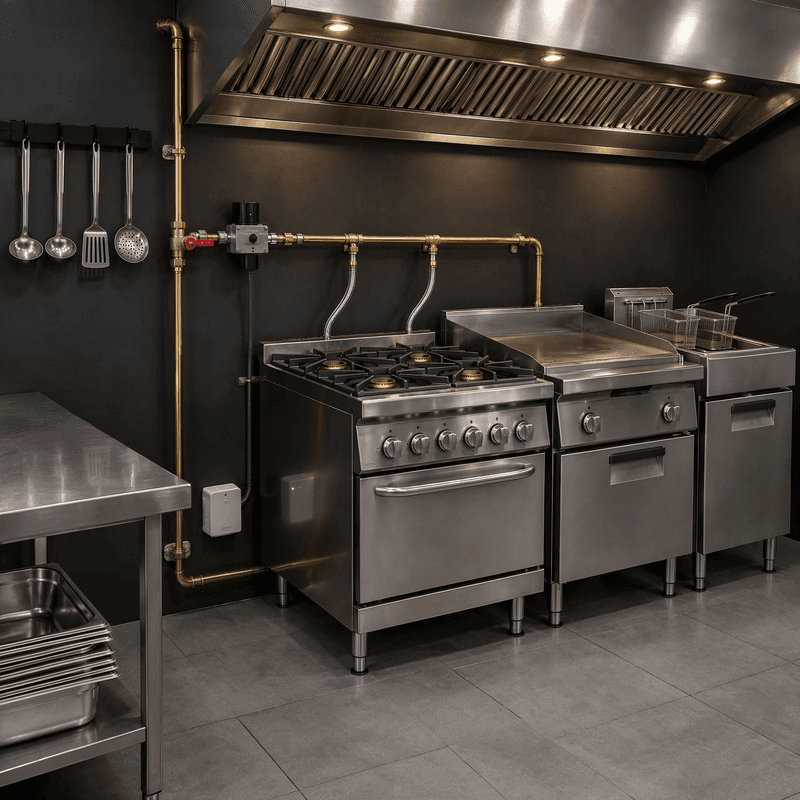
A gas leak detector warns you; an automatic shut-off valve acts. Mounted at the right height, wired to a fail-safe valve, and tested on a schedule, the two give an LPG kitchen a dependable first response to a leak.
Article
The short answer
A gas leak detector senses LPG in the air and raises an alarm while the concentration is still well below the level at which it could ignite. An automatic shut-off valve, usually a solenoid valve on the supply pipe, closes when it receives that alarm and cuts the gas to the appliances it serves. Together they turn a warning into an action, so a leak can be isolated even when nobody is standing at the cooker.
Neither device replaces a correctly designed and pressure-tested installation, clearly marked manual isolation valves, or people who know what to do. The World Liquid Gas Association’s guidance for commercial kitchens makes the same point: detectors are worth having, but users should not become so dependent on them that the basics slip.2 Think of detection and automatic shut-off as a safety layer on top of good engineering, not a substitute for it.
Why LPG detectors are mounted low
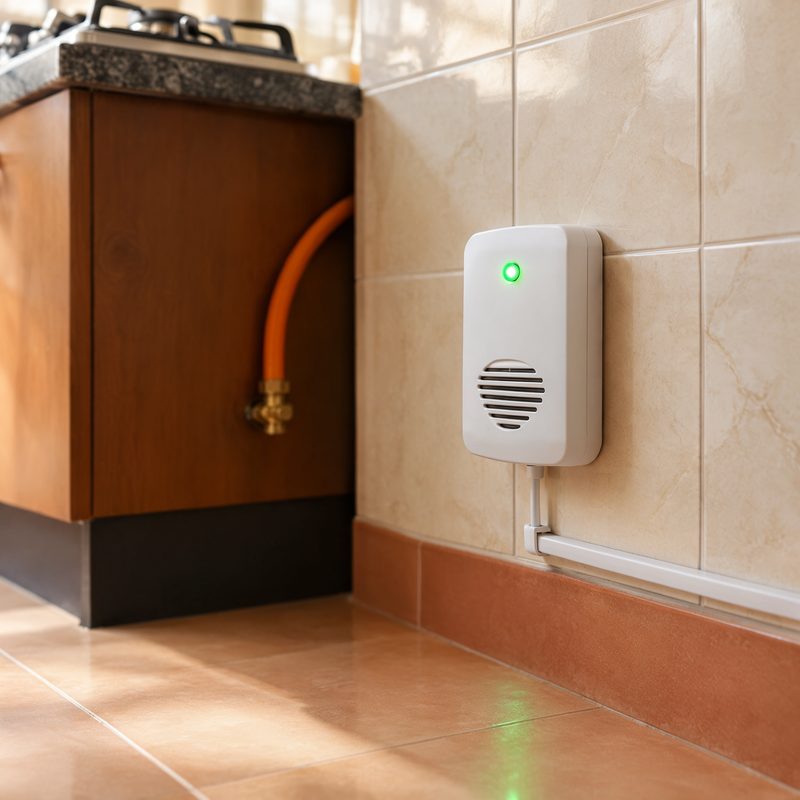
LPG is a mixture of propane and butane, and its vapour is heavier than air.2 When it escapes, it tends to sink and spread along the floor, collecting in low points, cupboards, drains, and corners rather than rising to the ceiling. A detector mounted high on the wall, where a smoke alarm would sit, can miss an LPG leak entirely.
Manufacturers’ installation instructions typically place LPG sensors roughly 20 to 40 cm above the floor, close to the points where a leak is most likely: the cooking line, the regulator, the cylinder or manifold area, and accessible pipe joints.3 The exact height and spacing should follow the instructions for the specific detector and the system designer’s layout. Keep the sensor away from strong draughts, extraction hoods, and places where mopping water, steam, or grease will reach it.
Natural gas behaves differently because it is lighter than air, so detectors chosen and positioned for natural gas are not interchangeable with LPG detectors.3 Specify the sensor for the gas actually in use on the premises.
How the automatic shut-off valve responds
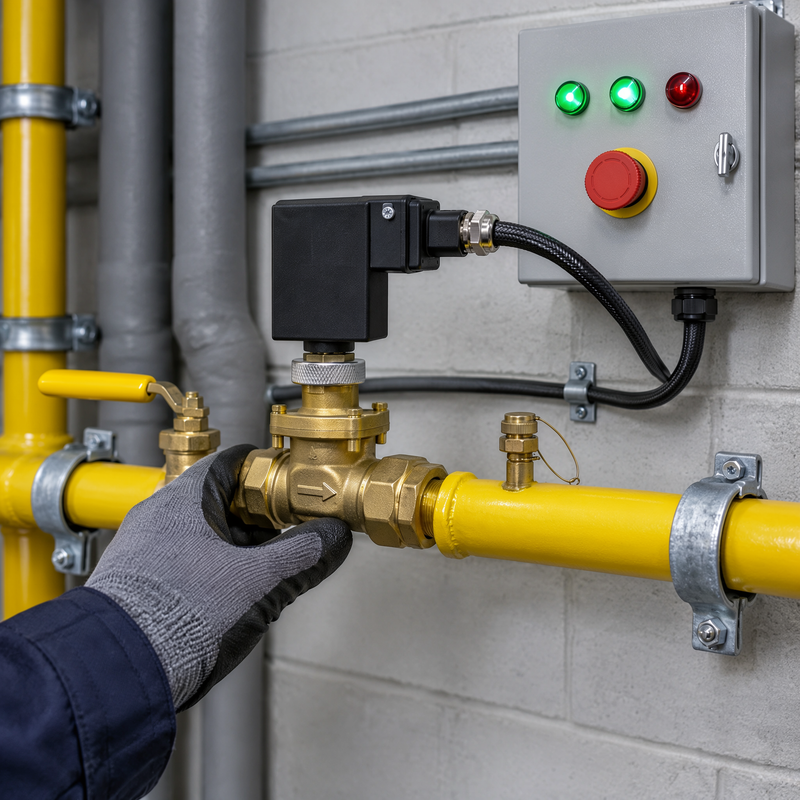
The most common automatic shut-off device is a solenoid valve: an electrically operated valve fitted on the gas line upstream of the appliances it protects. For safety duty it is normally specified as a fail-safe, normally closed valve. It needs power and a healthy signal to stay open, so it closes on a gas alarm, an emergency-stop button, a fire-alarm signal, or a loss of power.
A well-designed system then requires a deliberate manual reset. That pause matters. Someone has to find out why the gas went off, confirm that appliances are turned off and the area is clear, and only then restore the supply, instead of the valve reopening on its own while gas may still be present.
In a commercial kitchen, the same valve is often used for a ventilation interlock, so gas can only flow while the extraction and supply fans are proven to be running.4 BS 6173, the British standard for installing gas-fired catering appliances, requires that interlock where mechanical ventilation is fitted.45 It is not automatically Kenyan law, but it is a useful benchmark when you specify a kitchen gas safety panel. Confirm the Kenyan approvals and fire-safety requirements that apply to your premises before relying on any external standard.
Other automatic devices work alongside the solenoid valve rather than replacing it. Flame failure devices on appliances stop gas to a burner if its flame goes out, regulators can be fitted with over-pressure and under-pressure shut-off, and excess flow valves can stop the flow if a hose ruptures.2
Homes, commercial kitchens, and labs need different layouts
In a home, a detector near the cooker or near the point where the gas line enters the kitchen, linked to a solenoid valve on that branch, is often a sensible starting point. In a reticulated development, each unit can be protected this way so that a leak in one home can be isolated without shutting off the whole building. Our gas reticulation work for the townhouses at Ineza in Runda, for example, included leak detection as part of the scope.
A commercial kitchen usually needs several sensors along the cooking line and near the supply equipment, a control panel that can take inputs from the detectors, fans, fire alarm, and emergency stop, and clear signage that tells staff what each alarm means. Laboratories with bench gas taps need detection planned around the benches and the room’s isolation arrangement. On larger institutional systems, such as the tank, vaporizer, and reticulation network we installed for the United Nations offices in Gigiri, leak detection is designed in from the start rather than added as an accessory at the end.
Testing and upkeep: a detector you never test is a guess
Gas sensors age and can drift. Each detector has a service life and a test or calibration interval set by its manufacturer, and grease, dust, cleaning chemicals, and humidity in a busy kitchen can shorten it. A detector that has quietly reached the end of its life looks exactly like one that still works.
A sensible routine includes a regular functional test that confirms the alarm sounds and the solenoid valve actually closes; a written record of every test, fault, and reset; replacement of sensors at the end of their rated life; and a fresh review whenever the kitchen layout, appliances, or extraction change. Solenoid valves and similar safety devices deserve particular attention during periodic inspection.2 EPRA’s guidance on LPG reticulation also gives weight to testing, maintenance, and end-user safety awareness after commissioning, not just to the installation itself.1
Questions to ask before you buy or accept a system
Before installation or handover, ask: Is the detector rated for LPG, and is it mounted at the height its manufacturer specifies? Which valve does it close, and does that valve close if the power fails? How is the system reset, and who is authorised to reset it? Is it linked to the ventilation, fire alarm, and an emergency stop where the site needs that? What is the sensor’s service life and test interval, and who keeps the test records?
If you smell gas, do not wait for an alarm to confirm it. Where it is safe to do so, close the nearest supply valve, avoid operating switches or using naked flames, leave the area, and call for help. Detection equipment supports that response; it does not replace it.
How we install, test, and maintain detection systems
At Continental Experts, we treat detection and automatic shut-off as part of the gas system, not as accessories added at the end. Before we select any equipment, we review the gas source and operating pressure, the connected appliances, the existing valves, regulators, and controls, and the people responsible for the property. Detectors are then chosen for LPG, positioned at the height and locations the manufacturer specifies, and connected to the solenoid valve that isolates the right part of the system. detection and automatic shut-off
Before handover, we confirm that the system does what it is meant to do. The pipework is pressure-tested, each detector is checked to raise the alarm, the solenoid valve is checked to close when it should, and the reset procedure is agreed with the people who will use it. Every stage is documented: the equipment installed and where it sits, the test results, and the isolation and emergency routine. The responsible team is shown how to recognise an alarm, isolate the gas, reset the system safely, and report a concern.
Our responsibility does not end at handover. Through our maintenance and service agreements, we carry out planned inspections and agreed servicing and testing of your detectors, shut-off valves, and wider gas installation, and we keep a clear record of what was checked, what was found, and what needs attention next. The scope and frequency are set around your installation, how it is used, and the manufacturer’s guidance, and you have one accountable point of contact for your gas system.
What we check at a planned inspection
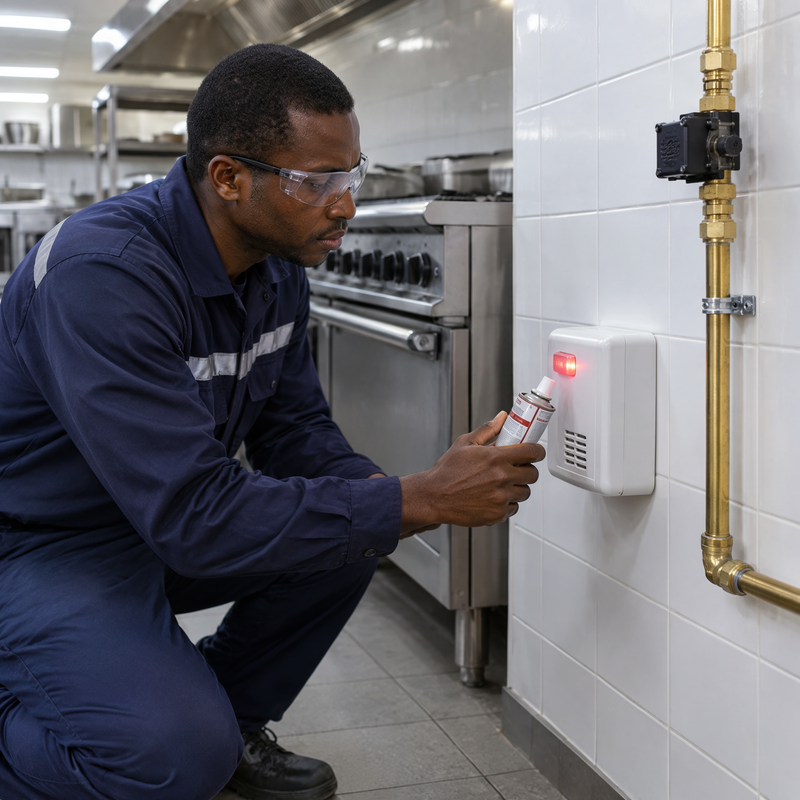
The exact checklist depends on the installation, but a planned inspection of a gas system with detection and automatic shut-off typically covers:
Detectors: condition, position, and a functional test confirming the alarm activates. Shut-off: confirmation that the solenoid valve closes on an alarm and that the reset procedure works as agreed. Isolation: manual isolation valves that are labelled, accessible, and operate freely. Pressure and supply: regulators, gauges, and the storage or manifold area. Pipework: visible pipework, joints, supports, and any alterations since the last visit. Records and people: test results logged, defects reported, and the responsible team still clear on what to do when an alarm sounds.
Anything that needs attention is recorded with a recommended next step, so you can decide on repairs or further assessment with full information rather than guesswork.
Planning a new kitchen or due for an inspection?
Planning a new kitchen, upgrading an existing installation, or unsure whether your detectors and shut-off valves still work? Send us your property type, the appliances you run, and any details of existing safety equipment and service records. We can review the layout, recommend a detection and shut-off arrangement that fits your premises, or set up regular inspection and testing for a system that is already installed. Send us your property type
References
Sources and further reading
- Energy and Petroleum Regulatory Authority (EPRA), Kenya. Guidelines on Licensing of LPG Reticulation (2025). View source
- World Liquid Gas Association. Guide to Good Industry Practices for LPG in Commercial Kitchens (2015). View source
- Watts. UR20S series gas detector: instruction manual. View source
- CIBSE Journal. Module 17: Commercial kitchen design for safety and energy efficiency. View source
- British Standards Institution. BS 6173:2020, Installation and maintenance of gas-fired catering appliances for use in all types of catering establishments (2020). View source