
Project guidance / 5 min read
What to ask your gas installation contractor before they start work.
Clear questions before installation reveal whether a contractor understands design, testing, documentation, and long-term responsibility.
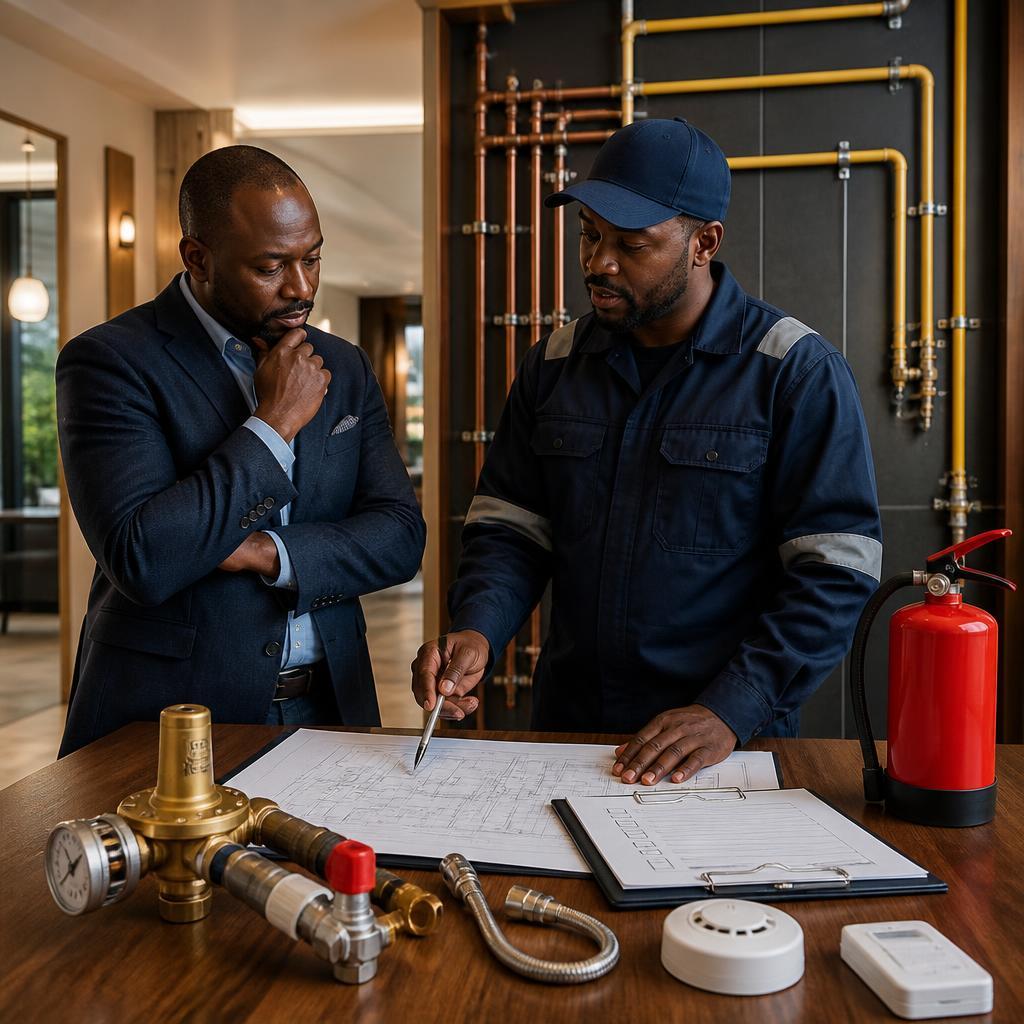
Clear questions before installation reveal whether a contractor understands design, testing, documentation, and long-term responsibility.
Article
Start with licensing and responsibility
Ask: “Are you licensed for this type of LPG installation, and can I verify the licence?” Kenya’s Energy and Petroleum Regulatory Authority (EPRA) publishes guidance for LPG installers and contractors, while Kenya’s LPG regulations set licensing and safety requirements for LPG business and installations. 1 2
Then ask who is responsible for the design, drawings, calculations, pipe routing, equipment selection, approvals, and coordination with architects, facilities teams, and other trades. A clear answer matters because the installer’s responsibility should cover more than connecting the last appliance. 1
Make the design and scope visible
Ask for a written scope and a drawing that show the cylinder or bulk-storage arrangement, regulators, pipe routes, appliance loads, valves, isolation points, ventilation, leak detection, and protection from damage. The contractor should be able to explain the layout in plain language, not only point to a catalogue. 1 2 3
Ask which approvals, inspections, and clearances apply before installation starts, and who will obtain them. Also ask how the design allows emergency responders and occupants to reach isolation valves, and what changes require the design to be reviewed again. 1 2
Ask how testing and commissioning will be done
Ask: “When will the pipework be pressure-tested, will it be tested in sections, and what test records will I receive?” Recognized gas-installation guidance treats testing, inspection, and safe installation as part of the system-not as an optional final check. 1 3
Ask who will purge and commission the system, what competence they hold, and how gas detection and leak checks will be managed. WLPGA guidance says commissioning and purging should be carried out by trained and competent persons, with controlled procedures and gas detection. 4
Do not accept handover without evidence
Before final payment, ask for as-built drawings, pressure-test and commissioning records, equipment manuals, warranties, licence details, isolation-valve locations, and a written operating and maintenance plan. Ask the contractor to walk you through the emergency shutoff and the steps to take if gas is suspected. 1 4
Finally, agree who will inspect and maintain the system, how often it should be checked, and how future alterations will be recorded. A contractor who can explain post-handover support is more likely to understand that LPG safety is a continuing responsibility, not a one-day installation task. 1 5
The red flags are usually simple
Be cautious if a contractor cannot show the relevant licence, will not provide a drawing or written scope, dismisses pressure testing, is vague about ventilation and emergency isolation, or wants to hand over the system without test records and operating instructions.
Choose the team that makes the installation understandable, measurable, and accountable before anyone opens the first valve. For a Kenyan project, use the international references below as technical guidance, then confirm the current Kenyan approvals, licence category, and inspection requirements that apply to the property.
References
Sources and further reading
- Energy and Petroleum Regulatory Authority (EPRA), Kenya. Guidelines on Licensing LPG Installers and Contractors (2025). View source
- Kenya Law. The Petroleum (Liquefied Petroleum Gas) Regulations (2019). View source
- National Fire Protection Association. NFPA 54, National Fuel Gas Code (2024). View source
- World Liquid Gas Association. Safety Alert: Commissioning and Purging LPG Installations (2022). View source
- World Liquid Gas Association. Guide to Good Industry Practices for Bulk LPG Installations (2018). View source